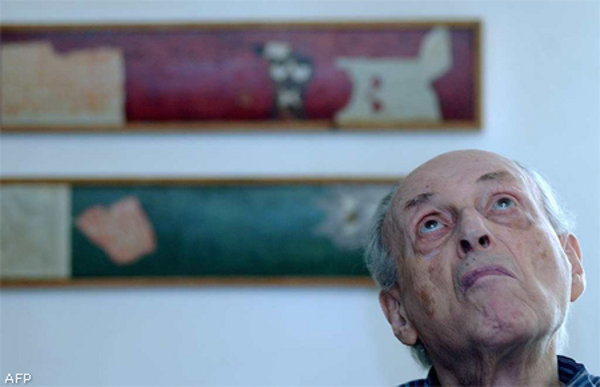

The photographer, born László Elkán in Hódmezővásárhely, Hungary, in 1910, left his homeland at the young age of 18. After a year in Vienna, he settled in Paris in 1929. He initially worked at a bank until 1939, after which he began writing articles and taking photographs for magazines.
During the Second World War, first in captivity and later in the resistance, he found the opportunity to engage with the arts, beginning to draw and paint. It was during this time that he adopted the pseudonym Hervé, which he later used as his professional name. Following the war, alongside active trade union and political activities, he resumed drawing, painting, and photographing for various publications.
The Turning Point: Collaboration with Le Corbusier
His career changed radically in 1949 when he met Le Corbusier. After seeing Hervé’s photographs of the construction of his housing block in Marseille, the renowned architect invited him to become his permanent photographer. From that point on, Hervé systematically documented all of Le Corbusier’s works and soon received numerous invitations from other contemporary architects to immortalize their projects. While the majority of Hervé’s oeuvre consists of these photographs of modern architecture, he also received commissions in the Middle East, India, and America, and took thousands of shots in France and Italy during his travels.
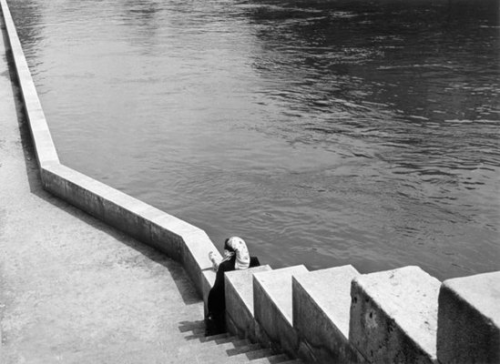
The uniqueness of his photography lies in his bold, rigorous, and geometric crops, built on the stark contrast between light and shadow—styles that remain free from a purely documentary approach. Le Corbusier famously remarked that through Hervé’s photos, he gained a deeper understanding of his own buildings.
A Humanist Vision Beyond Buildings
Today, Hervé is regarded as the most original and significant representative of architectural photography. However, throughout his career, he explored numerous other themes, capturing small, seemingly insignificant details of the street and sensitively grasping the relationship between humans and their living spaces. Unlike many of his contemporaries, he avoided anecdotal genre scenes; his photos, despite their strict composition, carry a deeply humane message. He chose geometric construction as his tool, guided toward this style by the art of Mondrian and the Constructivists.
Even during a severe illness starting in 1965, Hervé was characterized by exceptional openness, vitality, and a drive to create. He continued to photograph in the final years of his life, producing numerous books, book designs, and organizing his own exhibitions.
The “Lucien Hervé 100” Exhibition
More than 150 solo exhibitions of Lucien Hervé’s work have been held worldwide. The representative selection presented at the Museum of Fine Arts (Budapest) covers a full career retrospective, organized into three major themes: Man, Architecture, and Abstraction. This thematic structure also allows for a chronological exploration of his lifework.
- Man and Paris: The first part of the exhibition features early series like the Eiffel Tower and PSQF (Paris Sans Quitter Ma Fenêtre – Paris without leaving my window). Hervé believed all his images were “humanist,” whether a person appeared in them or not.
- The Spine of the Oeuvre: The architectural photographs form the core, featuring the world-famous collaboration with Le Corbusier, as well as commissions for the UNESCO headquarters (Marcel Breuer-Nervi-Bernard Zehrfuss), Le Havre (Auguste Perret), and Brasília (Oscar Niemeyer). His work also highlights historical and vernacular architecture in India and Europe, aiming to reveal the underlying ideas behind the structures.
- Abstraction: In the third section, objects like a decaying wall or a torn poster take on new meaning through Hervé’s lens. These details, removed from their context, become abstract forms, proving that even the “uninteresting” can be beautiful.
The “Lucien Hervé 100” exhibition also served as the opening event for PhotoMonth2010, a biennial event series organized by the Association of Hungarian Photographers to showcase world-class photography and integrate Hungarian artists into the international artistic bloodstream.
Lucien Hervé fotói