Golden Hour to Blue Hour in Central Europe
Exploring the transition from golden hour to blue hour in Budapest, this guide breaks down how Central European light behaves over the Danube and how photographers can use it for dramatic cityscape compositions. Using a real-world example captured on the banks of the river facing the Buda Castle and Chain Bridge, the article demonstrates how timing, atmosphere, and urban geometry define mood in low-light photography.

Photographing the Danube Light by Night in Budapest
The transition between day and night is one of the most technically and visually important phases in photography. In Central Europe, this shift is particularly expressive due to the combination of low sun angles, seasonal atmospheric haze, and dense architectural silhouettes.
Budapest offers a controlled yet visually complex environment for studying this phenomenon. The city’s river axis, formed by the Danube, divides two structurally and visually distinct urban landscapes, making it an ideal natural studio for observing light behavior.
Budapest as a Natural Laboratory for Twilight Photography
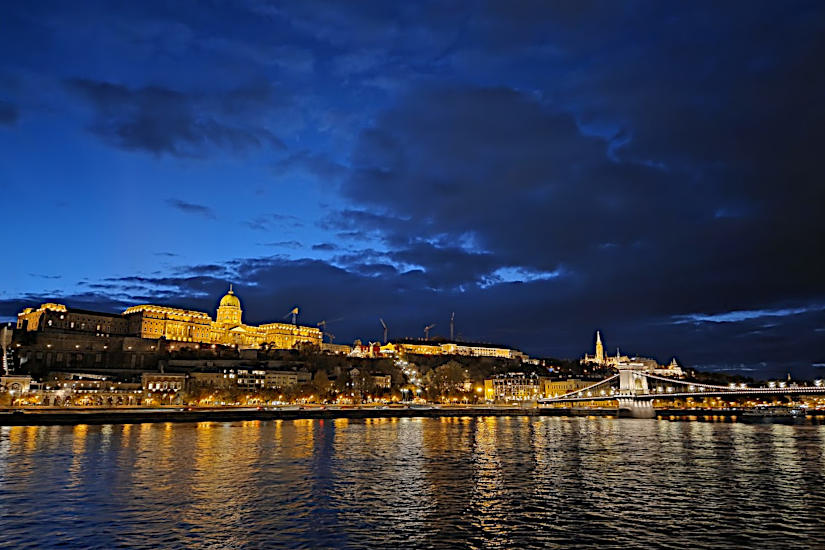
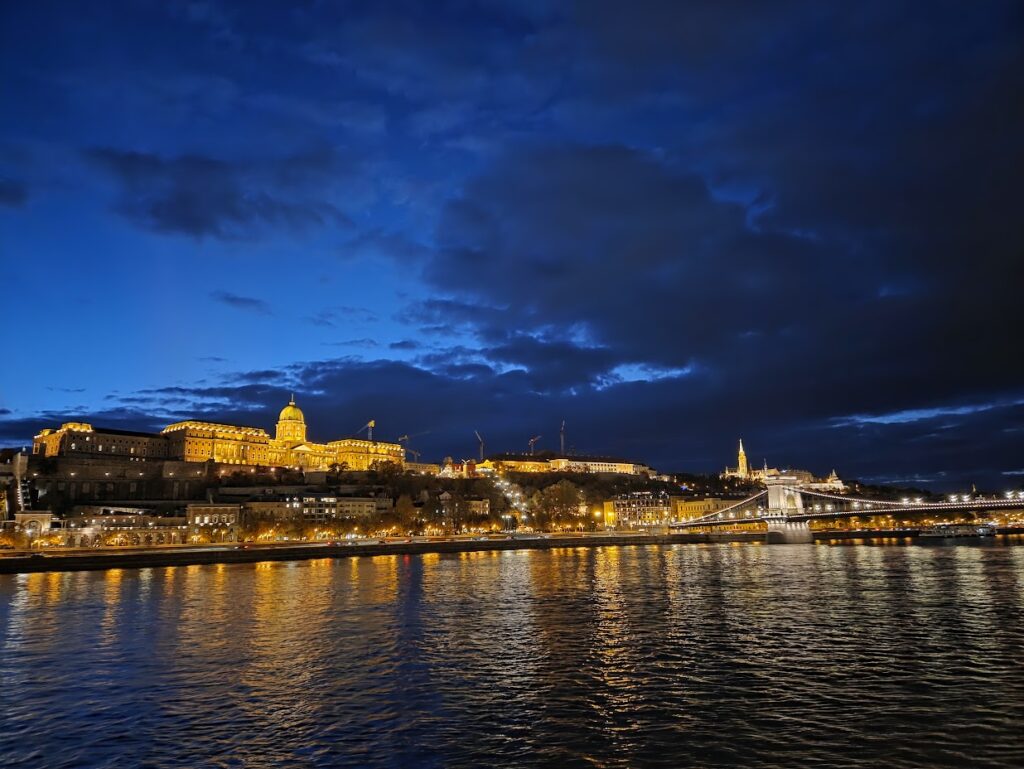
A photograph taken from the Pest riverbank, facing the illuminated silhouette of the Buda Castle and the Chain Bridge, captures this transitional light state. While the image was recorded on a mobile device, the technical limitations are secondary to the strength of timing and composition.
In this type of scene, the defining factor is not equipment but exposure timing. The moment when residual sunlight fades and artificial city lighting begins to dominate creates a hybrid lighting environment. This is often referred to as the blue hour transition.
The Role of the Danube in Light Reflection and Composition
The Danube functions as a reflective medium, amplifying both natural and artificial light sources. Even minimal ambient illumination from streetlights and buildings becomes visually significant when mirrored on the water surface. This doubling effect enhances contrast and depth perception.
Architectural landmarks such as the Chain Bridge and Buda Castle become silhouette anchors in this lighting phase. Their structural outlines remain readable even as color information diminishes, which strengthens composition clarity in low light conditions.
Compositional Structure: Foreground, Midground, and Background Layers
From a compositional standpoint, riverbank positioning is critical. The horizontal division created by the waterline naturally enforces a layered structure: foreground (river), midground (reflections and bridge), and background (castle and sky gradient). This layering is one of the most consistent strengths of Budapest as a photographic subject.
Exposure control in this scenario requires balancing highlight retention with shadow preservation. Mobile sensors, while limited in dynamic range compared to full-frame systems, can still produce usable results when the exposure is locked on mid-tones rather than bright light sources.
Understanding the Golden Hour to Blue Hour Transition
One of the key challenges in Central European twilight photography is the rapidity of light change. Unlike more equatorial regions, the transition from golden hour to full night can compress into a relatively short timeframe, demanding pre-visualization and fast execution.
This makes location familiarity more important than equipment upgrades. Understanding where light sources will appear in the frame before they activate allows for predictive composition rather than reactive shooting.
Exposure Challenges in Rapidly Changing Light Conditions
In the case of Budapest, the architectural lighting of major landmarks is often synchronized with dusk progression, creating predictable illumination patterns. This allows photographers to plan framing sequences rather than single exposures.
Color temperature shift is another defining characteristic. The warm tones of sunset gradually give way to cooler blue and cyan ambient tones, while artificial lights introduce localized warm highlights. This duality creates natural color contrast without post-production intervention.
Smartphone Photography in Low-Light Urban Environments
Even when captured on a smartphone, this environment supports strong post-processing latitude. However, the strongest results typically come from minimal correction, preserving the natural gradient between sky, water, and illuminated architecture.
For photographers working in urban environments, this type of scene represents an optimal learning framework: it combines composition, exposure control, and environmental timing in a single controllable scenario.
Lessons from Central European Urban Night Photography
Budapest, with its river-centered geography and layered architectural skyline, remains one of the most efficient European cities for studying these principles in practice.
📷 tech info:
Samsung Galaxy S25
ƒ/1,8
1/20
5,4 mm
ISO2000