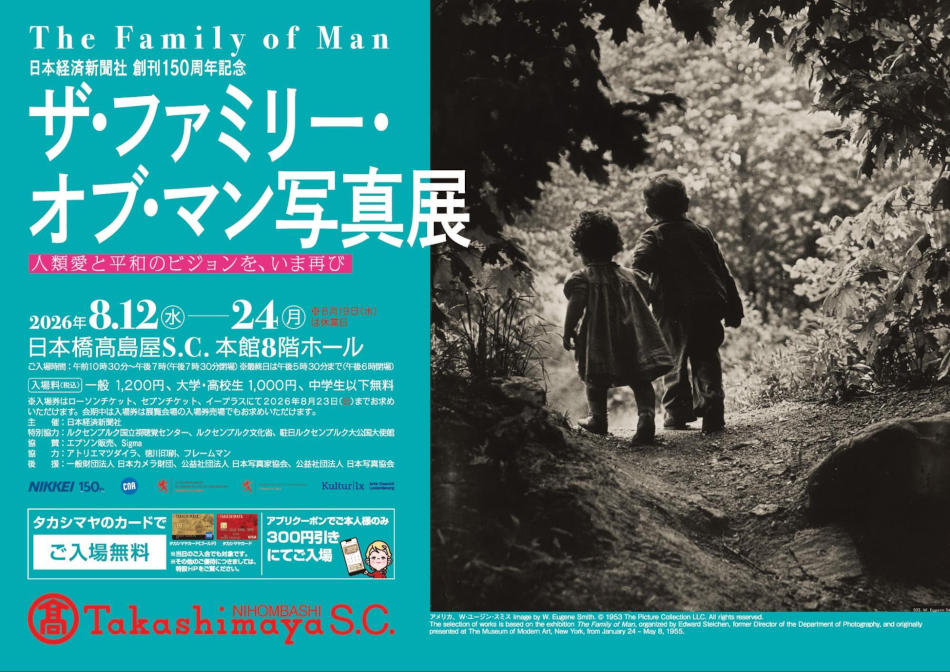
Sigma Sponsors a Historic Photography Exhibition in Tokyo
The Family of Man returns to Nihombashi Takashimaya in Tokyo from August 12–24, 2026. Sponsored by Sigma, the retrospective presents approximately 115 historic works alongside contemporary photography from Japan and Luxembourg, revisiting Edward Steichen's influential vision seven decades after the exhibition first reached Japan.

A landmark photography exhibition, The Family of Man returns to Nihombashi after 70 years
Seventy years after it first attracted audiences across postwar Japan, The Family of Man photography exhibition will return to Nihombashi Takashimaya in Tokyo from August 12 to August 24, 2026. Sigma Corporation will sponsor the exhibition, which revisits one of the most influential photographic projects of the 20th century and places its original humanist themes alongside contemporary photography from Japan and Luxembourg.
The exhibition will take place at the 8th-floor Hall of the Nihombashi Takashimaya S.C. Main Building. Organized as part of Nikkei Inc.’s 150th anniversary program, the 2026 presentation brings together approximately 115 works selected from the original exhibition, while also introducing around 50 contemporary photographs by Japanese and Luxembourg photographers and photojournalists. The organizers describe the project as an attempt to reconsider the exhibition’s ideas of humanity and peace from a contemporary perspective.
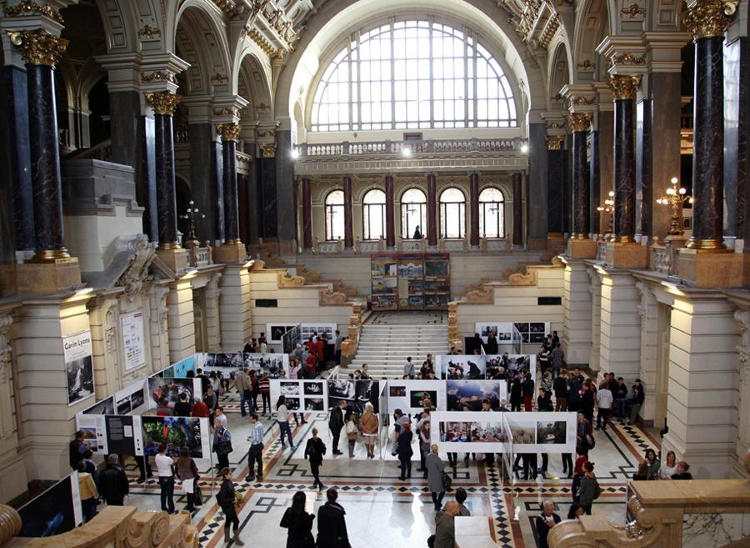
For photographers and photography historians, the event is significant for more than its historical anniversary. The Family of Man changed the way large-scale photography exhibitions could be conceived and experienced. Instead of presenting photographs primarily as individual works, curator Edward Steichen constructed an extensive visual sequence in which hundreds of images formed a broader narrative about human life.
From MoMA to Japan: the origins of The Family of Man
The original The Family of Man opened at the Museum of Modern Art in New York in 1955. Edward Steichen, who was then director of MoMA’s Department of Photography, conceived and curated the exhibition. The original project brought together 503 photographs by 273 professional and amateur photographers from 68 countries. UNESCO later described the exhibition as an important expression of postwar humanist photography and recognized its cultural and historical significance.
Steichen organized the photographs around 32 themes arranged as a progression through human existence. Birth, childhood, family, work, love, suffering, conflict and death appeared alongside images of everyday life from different parts of the world. The structure encouraged visitors to compare apparently distant cultures through recurring human experiences rather than through national or political categories.
The exhibition subsequently travelled internationally and became a major public event. According to the organizers of the 2026 Japanese retrospective, the original exhibition was seen by more than nine million people worldwide. In Japan, the first presentation opened at Nihombashi Takashimaya in 1956 and subsequently travelled to more than 20 cities, attracting approximately one million visitors.
The Japanese presentation also involved prominent figures from the country’s postwar cultural scene. Photographer Ihei Kimura participated in the organizing committee, while architect Kenzo Tange was involved in the exhibition environment. The combination of photography, architecture and large-scale visual presentation helped make the event more than a conventional collection of photographic prints.
A photographic exhibition built around relationships between images
One of the defining characteristics of The Family of Man was Steichen’s emphasis on the relationship between photographs. The individual image was important, but the sequence in which images appeared created an additional layer of meaning. Contemporary accounts from UNESCO also noted that photographs could acquire a different significance when presented as part of a larger group or visual arrangement.
This approach had a lasting influence on exhibition design and photographic presentation. Instead of treating photography exclusively as a collection of isolated masterpieces, Steichen used scale, juxtaposition, repetition and thematic progression to construct a visual argument. The result positioned photography as a medium capable of communicating ideas through editing and installation as well as through individual images.
The distinction remains relevant to contemporary photography. A photograph can communicate one meaning when viewed independently and another when placed beside an image from a different country, period or social context. In this respect, The Family of Man also provides an early example of the importance of sequencing and curatorial interpretation in photographic exhibitions.
Robert Capa, Henri Cartier-Bresson and a generation of photographers
The original exhibition included photographs by some of the most influential photographers of the period. Robert Capa, Henri Cartier-Bresson, W. Eugene Smith, Werner Bischof, Alfred Eisenstaedt, Nina Leen and numerous other photographers contributed to the visual vocabulary of the project.
The 2026 retrospective retains examples of this historical material. Among the works highlighted by the organizers are Wynn Bullock’s Child in Forest from 1951, Robert Capa’s photograph of a wedding in postwar Czechoslovakia, Werner Bischof’s Mother and child in a famine stricken area from 1951, and W. Eugene Smith’s The Walk to Paradise Garden from 1946.
The selection also includes photographs that connect the history of photography with specific moments in modern history. John Florea’s photographs of Japan’s first postwar general election document the country’s political transition, including the first participation of Japanese women in a national election. Yosuke Yamahata’s photographs made in Nagasaki on August 10, 1945, record the consequences of the atomic bombing from the perspective of civilians and the devastated city.
These photographs demonstrate one of the central characteristics of the exhibition: it moves between private and public life. Family portraits, children, work and everyday activities appear alongside photographs of war, famine, political institutions and social disruption. The result creates a visual structure in which personal experience and historical events remain connected.
W. Eugene Smith’s The Walk to Paradise Garden
Among the best-known photographs included in the retrospective is W. Eugene Smith’s The Walk to Paradise Garden. Smith photographed his children walking hand in hand toward a wooded area in 1946, after recovering from severe injuries sustained while working as a war photographer.
The photograph later became closely associated with Smith’s photographic legacy and with the conclusion of The Family of Man. In the exhibition’s original structure, the image provided a transition from the destruction and suffering associated with war toward children and the future. The 2026 exhibition again places the work within this broader historical and visual context.
For contemporary viewers, the image also demonstrates how a photograph can acquire significance through its position within an exhibition. Viewed independently, it is a photograph of two children walking through a garden. Within Steichen’s sequence, however, its meaning becomes connected to the themes developed throughout the exhibition.
From postwar humanism to contemporary photography
The 2026 exhibition does not simply reproduce the historical selection. Approximately 50 contemporary works will accompany the retrospective, with around 25 photographs from Japan and around 25 from Luxembourg. The Japanese section will include work by Nikkei photojournalists who have covered subjects in Japan and internationally.
The contemporary Japanese photographs address subjects including conflict, natural disasters, climate change and migration. The Luxembourg section is being developed with the country’s National Audiovisual Centre, or CNA, and introduces contemporary photographers whose work responds to the ideas associated with Steichen’s original exhibition.
This structure gives the 2026 exhibition a second chronological layer. The historical photographs document the concerns and visual culture of the mid-20th century, while the contemporary works ask how similar questions appear in the 21st century.
The timing also has a diplomatic dimension. Japan and Luxembourg will mark the centenary of their diplomatic relations in 2027. The inclusion of Luxembourg photographers and photojournalists therefore connects the history of The Family of Man with Steichen’s Luxembourg origins and with the current cultural relationship between the two countries.
The exhibition’s Luxembourg connection
Steichen was born in Luxembourg in 1879 and later moved to the United States with his family. The connection between the exhibition and Luxembourg became particularly important later in its history. After the international tour, the collection was transferred to Luxembourg and eventually installed permanently at Clervaux Castle.
UNESCO added The Family of Man to its Memory of the World Register in 2003. UNESCO identifies the collection as an important document of the postwar period and notes its relationship to the visual history of the Cold War era, humanist photography and international aspirations for peace.
The permanent presentation at Clervaux also established a long-term institutional framework for preserving the exhibition. According to UNESCO, the museum attracted more than 163,000 visitors from around the world between its opening in 1994 and the time documented in UNESCO’s register material.
Why the 2026 retrospective matters to photography history
The historical importance of The Family of Man does not rest only on the reputation of the photographers involved. Its significance also lies in the way it treated photography as an exhibition medium. Steichen used photographs as elements within a carefully constructed sequence, demonstrating that the arrangement of images could become part of the photographic message itself.
That approach anticipated exhibition practices that are now familiar in museums and photography festivals. Large-scale installations frequently rely on sequencing, scale, wall text, archival material and spatial relationships to guide interpretation. The Family of Man represents one of the major historical examples of this approach.
At the same time, the exhibition’s humanist framework has generated critical discussion. The idea of presenting people from very different cultural and political circumstances as members of one universal human family can create connections between images, but it can also reduce differences in historical circumstances and social conditions. This tension has become part of the exhibition’s later critical history and provides an additional reason to examine the project in its historical context.
The 2026 presentation therefore offers an opportunity to see the photographs while also considering how exhibition design influences interpretation. The question is not simply what an individual photograph depicts, but how its meaning changes when it becomes part of a carefully edited visual sequence.
Sigma’s role in supporting photographic culture
Sigma’s sponsorship connects the exhibition with a contemporary camera and lens manufacturer whose business is closely associated with photographic and optical engineering. Sigma has described support for photographic and visual arts as part of its corporate mission, alongside its involvement in festivals, cultural events and photobook initiatives.
The company was founded in 1961 and operates its principal manufacturing base in Aizu, Japan. Its sponsorship of The Family of Man places a current Japanese photographic manufacturer alongside a project that has occupied an established position in international photography history.
For Sigma, the connection is also consistent with the company’s stated emphasis on the relationship between engineering and photographic creativity. The company describes this philosophy through the phrase “The Art of engineering. Engineering for Art.” Its support of the 2026 exhibition extends that relationship beyond equipment production into the cultural history of photography.
A return to the same Tokyo location
The physical location adds another layer to the event. The 2026 exhibition returns to Nihombashi Takashimaya, the same department store where the original Japanese presentation opened in 1956. The return creates a direct geographical connection between the historical exhibition and its contemporary retrospective.
The venue will host the exhibition from August 12 through August 24, 2026, with a closure on Wednesday, August 19. Opening hours are scheduled from 10:30 to 19:00, with the hall closing at 19:30. On the final day, August 24, admission ends earlier, at 17:30, with the venue closing at 18:00.
Admission is set at ¥1,200 for adults and ¥1,000 for university and high-school students, while junior-high-school students and younger visitors can enter free of charge. The organizers also note that visitor numbers may be restricted if the venue becomes crowded.
The Family of Man as a photographic archive and exhibition
The 2026 retrospective ultimately brings together several different dimensions of photographic history: the development of humanist photography after the Second World War, the emergence of photography as a major museum and exhibition medium, the international circulation of photographic images, and the changing role of photojournalism.
Its contemporary section also places the historical photographs in direct conversation with current documentary practice. Conflict, migration, environmental change and disasters remain subjects for photographers, but the visual environment in which those photographs circulate has changed substantially. Digital photography, social media, online news platforms and continuous image distribution have transformed both production and consumption.
That makes the exhibition relevant not only as an historical reconstruction but also as an opportunity to examine how photography communicates across generations. The original exhibition was created in an era when printed photographs and large physical exhibitions could reach mass audiences. The 2026 edition presents that history in a period when billions of photographs circulate digitally every day.
A photographic dialogue across seven decades
The return of The Family of Man to Japan consequently establishes a dialogue between two photographic eras. The historical selection documents the visual culture of the 1940s and 1950s, while contemporary Japanese and Luxembourg photographers address subjects that define the present.
The exhibition does not reproduce the original 500-plus-image presentation in its entirety. Instead, it selects approximately 115 works from the historical exhibition and places them alongside contemporary photographs. This makes the 2026 event a retrospective interpretation rather than a literal reconstruction of the 1955 exhibition.
For Photonet readers, that distinction is important. The event provides an opportunity to study not only the photographs themselves, but also the editorial and curatorial decisions that determine how photographs acquire meaning when presented together.
Seventy years after The Family of Man first arrived at Nihombashi Takashimaya, the same location will once again become a meeting point for photographic history and contemporary visual journalism. With Sigma as a sponsor and with photographers from Japan and Luxembourg contributing new perspectives, the 2026 exhibition places one of the most consequential projects in 20th-century photography into a new temporal and cultural context.
The central question remains open to the visitor. Rather than presenting the historical photographs simply as documents of another period, the retrospective asks how images made decades ago continue to function when placed beside photographs of today’s world. In that sense, The Family of Man returns to Japan not only as an exhibition of photographic history, but as an examination of how photography constructs connections between individual lives, societies and generations.
The Family of Man Photo Exhibition
Wednesday, August 12 – Monday, August 24, 2026
10:30 – 19:00 (Close at 19:30)
– 17:30 on the last day (Close at 18:00)
Closed on Wednesday, August 19
Venue: Nihombashi Takashimaya SC Main Building, 8th Floor Hall