Hemző Károly and the Evolution of Hungarian Documentary Photography
A Budapest exhibition marks fifty years since Hemző Károly's 1976 Találkozásaim exhibition by bringing his vintage photographs into dialogue with the work of Hemző Prize winners and contemporary Hungarian documentary photographers.

Fifty Years After Találkozásaim, a New Generation Meets Hemző Károly
Hungarian photography is returning to one of its important points of reference with New Encounters: 1976–2026 – Hemző and the Hemző Prize Winners, an exhibition at the Műcsarnok in Budapest. The exhibition marks fifty years since Hemző Károly presented his Találkozásaim (My Encounters) exhibition at the same institution in 1976. Rather than simply reconstructing a historic exhibition, the current presentation places Hemző’s photographs in dialogue with the work of younger Hungarian photographers associated with the Hemző Károly Prize.
The exhibition provides an opportunity to examine how photographic approaches can continue across generations without producing identical visual languages. Hemző’s work belongs to a period when Hungarian documentary photography developed within a distinctive cultural and institutional environment. The photographers represented by the Hemző Prize, by contrast, work in a media landscape shaped by digital photography, online publishing, changing news cycles and new documentary practices. Bringing the two periods together makes it possible to consider both continuity and transformation.
Hemző Károly and the Changing Role of the Photographer
Hemző Károly’s career crossed several areas of photography. He began with sports photography and later worked as a photojournalist and picture editor, while also producing book photography, documentary images, portraits, urban scenes and photographs connected with food and horses. His career therefore provides a useful example of how a photographer could move between editorial assignments, independent photographic work and visual publishing.
His professional path also shows how photography operated before the transition to today’s predominantly digital workflow. Hemző worked extensively with photographic film and darkroom processes, and many of the vintage prints presented in the exhibition were made by the photographer himself. The physical act of selecting negatives, exposing photographic paper, processing prints and determining the final tonal balance formed an integral part of the photographic production process.
This aspect is particularly relevant to contemporary viewers because the exhibition does not present Hemző’s photographs simply as historical documents. The original or vintage prints also preserve evidence of the photographer’s working method. The surface, tonal structure and presentation of a darkroom print can therefore become part of how the viewer encounters the image.
Reconstructing the 1976 Exhibition
One of the central elements of New Encounters recalls Hemző’s 1976 Találkozásaim exhibition. The reconstruction is not intended merely as a chronological display. It examines the photographic and presentation strategies that Hemző used at the time and considers how those decisions contributed to the way audiences encountered his work.
The 1970s were an important period for Hungarian photography. Photographers including Tamás Féner, Péter Korniss, Róbert Horling, Irén Ács, Edit Molnár and Károly Hemző received exhibition opportunities at the Műcsarnok. Their presence indicates the growing visibility of photography within the Hungarian art and cultural institution system of the period.
The reconstructed material also demonstrates the range of Hemző’s photographic interests. Sports photographs, urban scenes and observations of everyday life appear alongside images connected with horses and other subjects that occupied a significant place in his work. Instead of presenting a single definition of Hemző as a photographer, the exhibition emphasizes the variety of approaches within his oeuvre.
From Sports Photography to Photojournalism
Hemző’s early association with sports photography became one of the recognizable elements of his career. Sports photography demands timing, anticipation and an ability to identify the decisive moment within rapidly changing situations. These skills can also inform documentary and photojournalistic work, where photographers must respond quickly while maintaining awareness of context and composition.
His later work as a photojournalist and picture editor expanded that role. The picture editor does not simply produce photographs but also participates in deciding which images communicate a story, how sequences are constructed and how photographs function alongside written material. This editorial perspective helps explain why Hemző’s influence extends beyond individual photographs to questions of photographic communication and presentation.
The exhibition therefore places emphasis not only on what Hemző photographed but also on how photographs functioned as part of a broader communication system. His images could appear in exhibitions, magazines, books and other forms of visual publishing, each requiring a different relationship between the photograph and its audience.
Photography, Books and the Visual Language of Food
Another important part of Hemző’s career developed through his collaboration with Lajos Mari. Together they created a series of cookbooks that reached a very large readership in Hungary. Their work demonstrates how food photography can operate simultaneously as documentation, illustration and visual communication.
The photographs associated with this part of Hemző’s career also broaden the conventional understanding of his work. Food photography requires careful attention to composition, lighting, texture, colour and the relationship between individual objects. In the context of a cookbook, however, the photograph also has to communicate information clearly enough to support the reader’s understanding of the subject.
The exhibition includes examples of gastronomic still-life photography and book covers, allowing visitors to see another aspect of Hemző’s visual practice. These images also connect photography with publishing history and show how a photographic style can become closely associated with a wider body of books and printed material.
The Darkroom as Part of Photographic History
The presence of vintage prints is particularly significant for understanding the historical dimension of the exhibition. Contemporary photographers often work within a digital workflow in which capture, editing, colour management and publication can occur within a single technological environment. Hemző’s generation worked with a more physically divided process.
A film negative provided the original recorded image, but the final print still depended on decisions made in the darkroom. Exposure time, paper selection, processing and enlargement all influenced the final result. When the photographer produced the print personally, these technical decisions became part of the author’s visual interpretation.
For younger photographers and for audiences accustomed to digital images, the vintage prints can therefore function as more than historical artefacts. They provide an opportunity to examine the material characteristics of analogue photography and the relationship between photographic capture and photographic printing.
An Influence Without a Classroom
Hemző did not establish his influence primarily through formal teaching. He did not run a photographic school or build his reputation as an academic instructor. His influence instead developed through professional relationships, published photographs, editorial work, exhibitions and the example provided by his photographic practice.
The exhibition identifies Bánkuti András and Bácsi Róbert László as important links between different generations. Bánkuti, who worked with and was a friend of Hemző, represents a direct connection with the earlier period. Bácsi represents a later generation and has also been involved in the Hemző Prize’s professional community.
This form of transmission is significant in photographic history. Photographic traditions do not necessarily move from teacher to student in a formal classroom. They can also pass through editorial environments, professional collaborations, competitions, exhibitions, books, personal relationships and the observation of other photographers’ working methods.
The Hemző Károly Prize and Contemporary Hungarian Photography
A Prize Connecting Generations
The Hemző Károly Prize was established in 2013 and has since become one of the mechanisms through which younger Hungarian photographers can gain professional recognition. The exhibition presents works by prize winners and finalists, creating a second chronological layer alongside Hemző’s photographs.
The participating prize winners include Hajdú D. András, Móricz-Sabján Simon, Mohai Balázs, Pályi Zsófia, Bielik István, Csudai Sándor, Végh László, Mónus Márton, Ruprech Judit, Melegh Noémi Napsugár, Szajki Bálint and Zoltai András. Their inclusion makes the exhibition a survey of several directions within contemporary Hungarian documentary photography.
The prize does not require its recipients to reproduce Hemző’s photographic style. Instead, the exhibition uses their work to examine how a professional legacy can remain relevant while individual photographers develop their own visual languages. The result is a comparison between different periods rather than an attempt to establish a single photographic aesthetic.
Documentary Photography in the 21st Century
The contemporary works presented in the exhibition also provide a broader view of documentary photography in the 21st century. Documentary photography has changed considerably since the 1970s, particularly in relation to technology, distribution and the speed at which images reach audiences.
Digital cameras and smartphones have reduced the technical barriers to image production, while online platforms have changed the way documentary photographs circulate. At the same time, the basic questions of documentary photography remain familiar: what should be photographed, from whose perspective, in what context and how should the resulting images be presented?
The Hemző Prize photographers approach these questions through individual projects and visual strategies. Their work demonstrates that documentary photography can encompass reportage, social observation, personal narratives and long-term projects while still maintaining a connection with photography’s role as a record of contemporary life.
Twelve Photographers in Dialogue With Hemző
An installation at the centre of the exhibition focuses specifically on photographs created as homages to Hemző. Twelve representatives of younger generations respond to his work, creating another form of connection between the historical and contemporary sections.
The significance of these images lies in the distinction between influence and imitation. A homage can acknowledge a predecessor while allowing the contemporary photographer to reinterpret a subject, method or visual idea through a different historical and technological context.
This approach also reinforces one of the exhibition’s central themes: documentary photography can maintain continuity without remaining static. A photographer from the 21st century can respond to an earlier generation while addressing subjects, audiences and social conditions that did not exist in the same form fifty years earlier.
Bánkuti András and Bácsi Róbert László as Bridges Between Generations
The role of Bánkuti András and Bácsi Róbert László extends beyond the presentation of individual photographs. Their professional involvement creates a bridge between Hemző’s generation and the photographers represented by the prize.
This generational connection is particularly relevant because the Hemző legacy is not presented as a closed historical chapter. Instead, it appears as part of an ongoing professional conversation about documentary photography, editorial responsibility and photographic quality.
The exhibition also includes video interviews with Lajos Mari, Bánkuti András, Péter Korniss and Bácsi Róbert László. These recordings add spoken recollections and professional perspectives to the photographic material, creating a direct link between personal memory and photographic history.
Remembering Hemző Through Photographs
Sport, Streets, Horses and Everyday Hungary
The range of subjects in the exhibition is central to understanding Hemző’s photographic legacy. His photographs document sports, urban life, people, horses and everyday situations, creating a broad visual record of Hungary during the second half of the 20th century.
The value of such photographs does not depend exclusively on their historical information. Documentary images also preserve visual details that written records may not capture in the same way: clothing, gestures, public spaces, vehicles, interiors, sporting environments and patterns of everyday behaviour.
For international audiences, these photographs provide an additional perspective on Hungary’s photographic history. They offer images of Hungarian life created from within the country’s own photographic and editorial culture rather than through an external documentary perspective.
The Balaton as a Photographic Subject
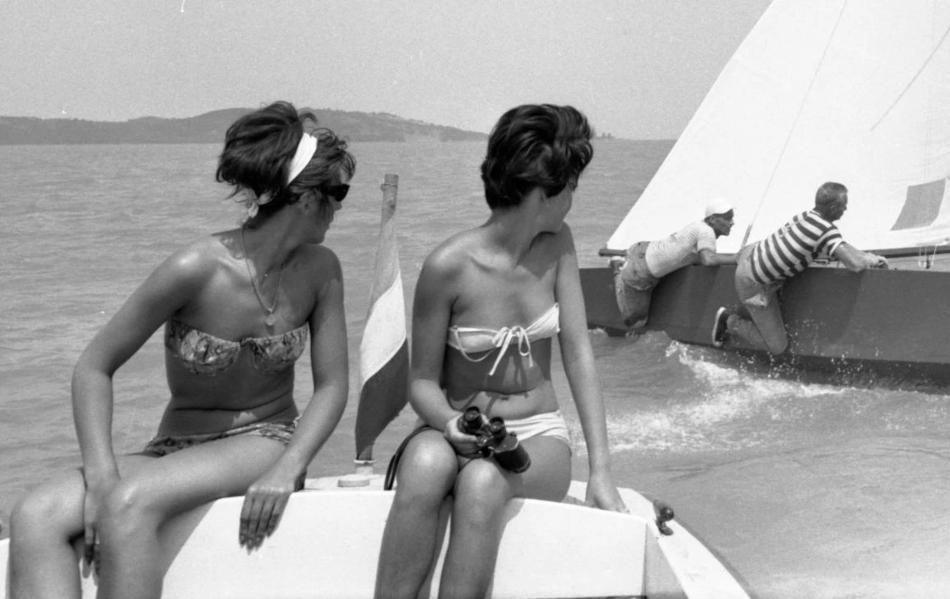
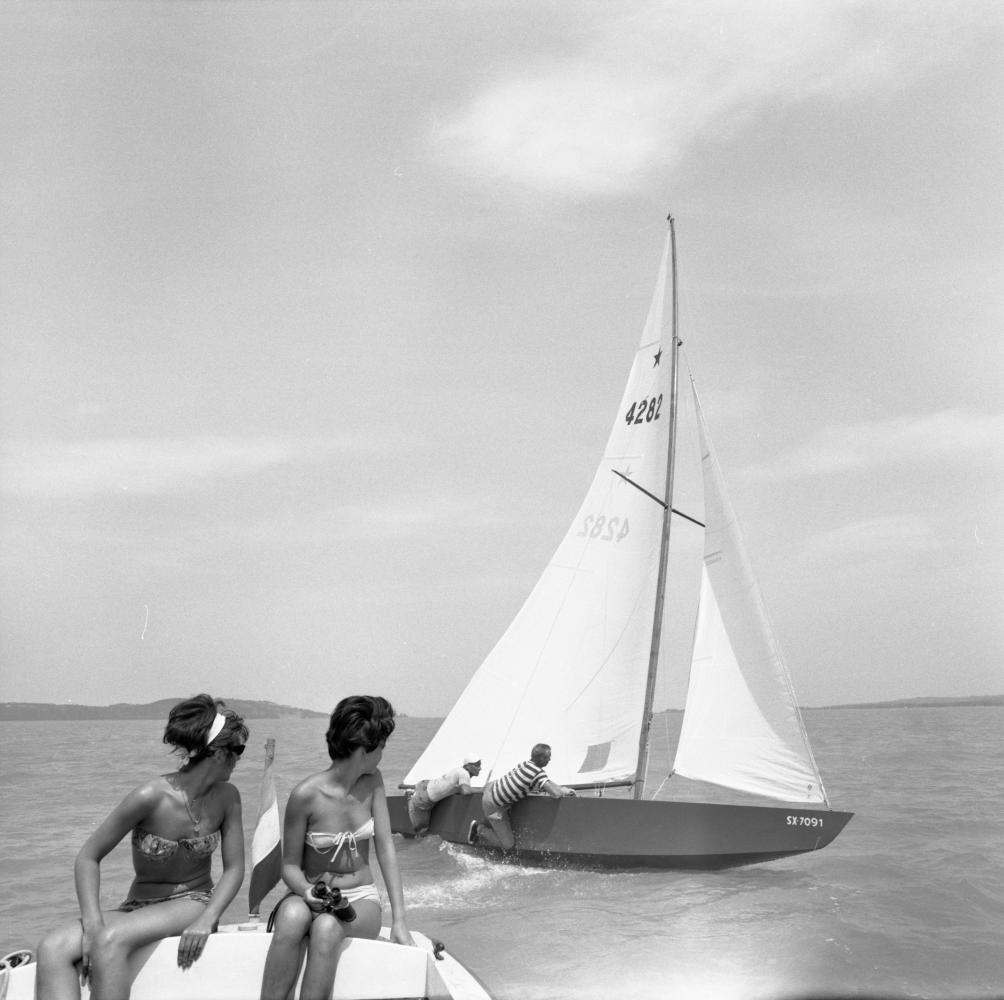
One of the images associated with the exhibition is Hemző Károly’s Sailing Race on Lake Balaton, a silver gelatin vintage print from the 1960s. The photograph represents one of the recurring aspects of Hemző’s work: the ability to combine documentary observation with carefully constructed photographic composition.
The Balaton has long been an important recreational and cultural landscape in Hungary, and photographs of the lake can therefore operate on several levels. A sailing race records a particular event, while the surrounding landscape, boats and spectators also become visual evidence of a period and its leisure culture.
The use of a vintage silver gelatin print is equally important. Silver gelatin printing dominated black-and-white photographic production during much of the 20th century and remains closely associated with the material history of fine-art and documentary photography. In this exhibition, the print is both an image and an example of the analogue photographic process through which Hemző presented his work.
From Historical Legacy to Contemporary Practice
The final section of the exhibition presents the diversity of contemporary Hungarian documentary photography through the winners of the Hemző Károly Prize. The selection does not attempt to define a single contemporary style. Instead, it demonstrates the range of approaches that can exist within the same broad photographic tradition.
The inclusion of two young prize-winning photographers who died prematurely, Csudai Sándor and Móricz-Sabján Simon, adds another layer to the presentation. Their photographs become part of the exhibition’s broader reflection on generations, photographic careers and the preservation of professional memory.
The exhibition’s structure consequently moves in several directions at once. It looks backward to Hemző’s 1976 exhibition, examines his wider career, follows the development of professional influence through later generations and then turns toward photographers working in the present century.
A Photographic Dialogue Across Fifty Years
New Encounters: 1976–2026 – Hemző and the Hemző Prize Winners can be understood as an exhibition about photographic continuity as much as an exhibition about one photographer. Its central question concerns how a professional approach can remain relevant after the technological, social and institutional environment around photography has changed.
Hemző’s photographs provide the historical starting point, while the Hemző Prize photographers demonstrate how documentary photography continues to develop in Hungary. Between the two stands a network of photographers, editors, colleagues, curators and professional institutions that transmit knowledge without necessarily doing so through formal education.
The exhibition also places renewed attention on the physical photograph. At a time when most photographic images are viewed on screens, the presentation of vintage prints makes the photographic object itself part of the discussion. The differences between a film negative, a darkroom print and a digitally produced image are not simply technical distinctions; they influence how photographs are produced, selected, edited and preserved.
For international audiences interested in documentary photography, Hungarian photography or the history of European photographic practice, the exhibition offers a specific case study in how a national photographic tradition can be revisited through contemporary practice. Hemző’s work provides the historical reference point, while the Hemző Prize photographers demonstrate that the conversation continues in different visual forms.
New Encounters: 1976–2026 – Hemző and the Hemző Prize Winners is curated by Klára Szarka. The exhibition is presented at the Műcsarnok in Budapest and remains on view until September 20, 2026. Its final programme includes a closing guided tour with the curator and participating artists, providing another opportunity to examine the relationship between Hemző Károly’s work and the generations that followed him.
Photos: Műcsarnok and Fortepan
Hemző Károly, Sailing Race on Lake Balaton, 1960s, vintage silver gelatin print
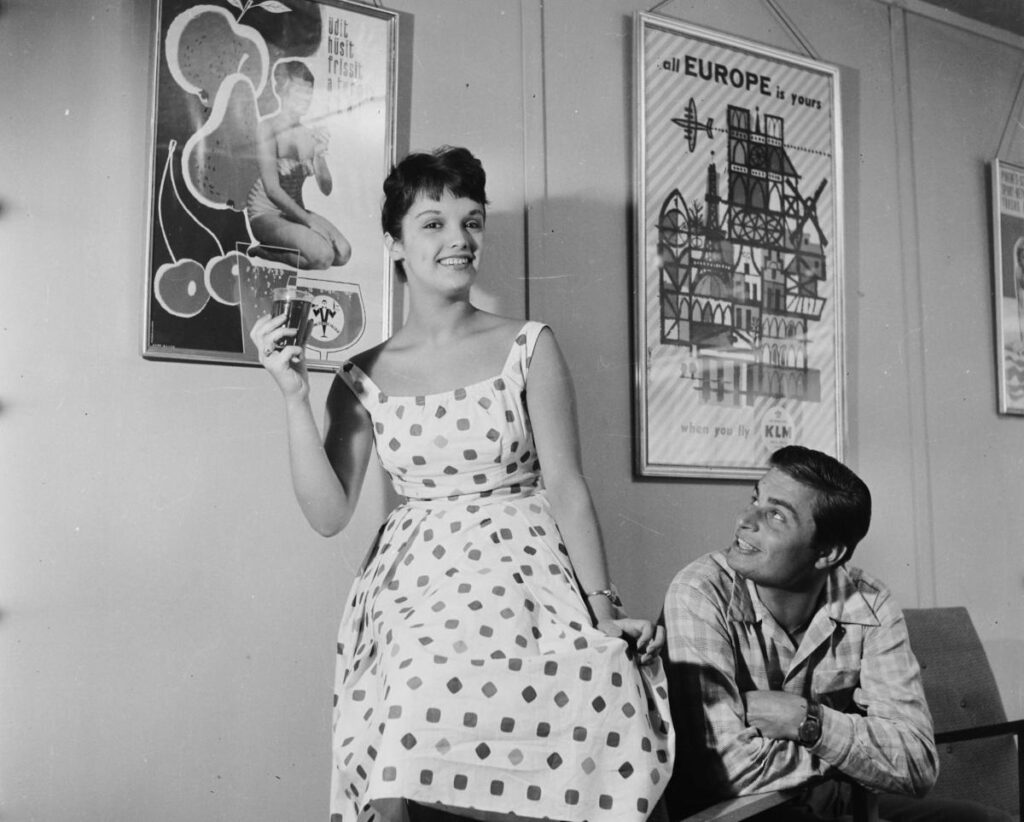
Glatz Henrik Street, Motel. Actress Cecília Dévényi and photographer Károly Hemző, 1959, Hungary, Balaton, Siófok.
Fortepan, Photo donated by Sándor Bauer.
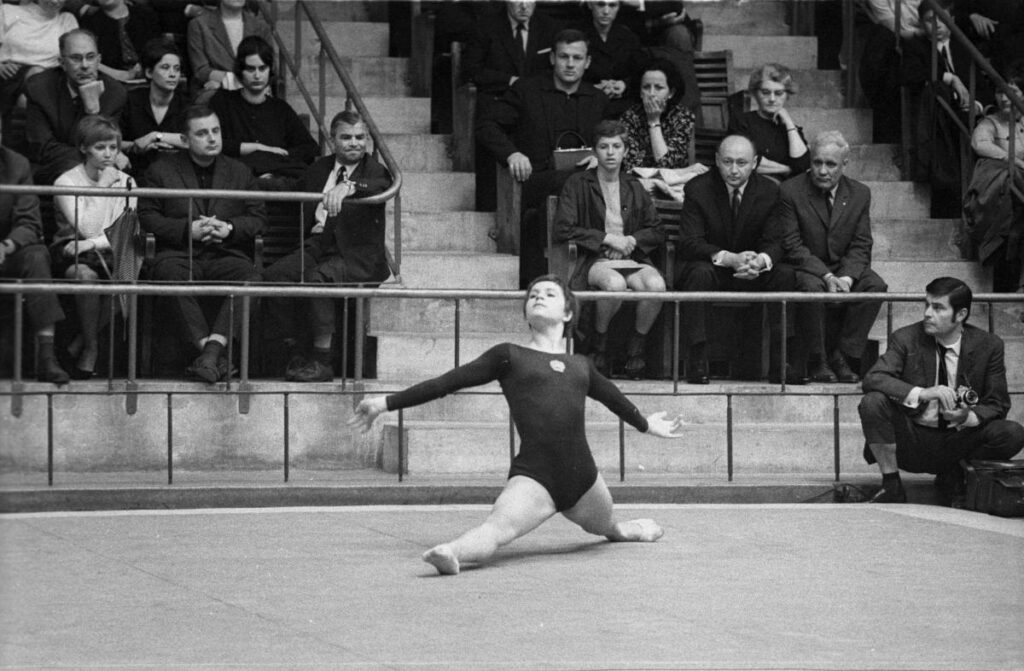
3–5 Istvánmezei Road, National Sports Hall (later Gerevich Aladár National Sports Hall). Katalin Makray, Olympic silver medalist gymnast. Biszku Béla is second from the right in the background. Photographer Károly Hemző is on the right, 1969, Hungary, Budapest XIV District.
Fortepan, Photo donated by Katalin Erdei.