RICOH GR IV 30th Anniversary Edition Celebrates 30 Years of the GR Series

RICOH marks three decades of the GR concept with a limited GR IV Anniversary Edition
Ricoh Imaging will mark the 30th anniversary of its GR series with the RICOH GR IV 30th Anniversary Edition Kit, a limited-edition version of its current premium compact camera. The special model combines the imaging platform of the RICOH GR IV with design details inspired by the original GR1 film camera, together with a collection of commemorative accessories. Ricoh Imaging has announced a worldwide production run of just 6,000 units, with availability scheduled to begin on October 21, 2026.
The anniversary edition continues a product concept that has remained largely consistent across three decades: combining high image quality, fast operation and a compact body intended for spontaneous photography. Rather than introducing a fundamentally different camera platform, Ricoh has based the anniversary model on the existing GR IV and concentrated the changes on its exterior treatment, controls and included accessories. According to Ricoh, the remaining camera specifications are the same as those of the standard GR IV.
From the GR1 film camera to the GR IV
The history behind the anniversary model begins in October 1996, when Ricoh introduced the RICOH GR1 film compact camera. The original model featured a 28mm F2.8 GR lens and established the combination of portability and image quality that subsequently became central to the GR product line. Ricoh identifies the GR1 as the origin of the current GR series.
The series later moved into digital photography with the introduction of the RICOH GR DIGITAL in 2005. That camera used a 1/1.8-inch CCD sensor with approximately 8.13 effective megapixels. Subsequent generations gradually increased sensor size and resolution while retaining the compact-camera concept. The GR history includes models such as the GR DIGITAL II, GR DIGITAL III, GR DIGITAL IV, GR, GR II, GR III and GR IIIx.
The current generation arrived with the RICOH GR IV in 2025. Ricoh introduced the model with a new lens, image sensor and image-processing engine, while also redesigning the camera body. The manufacturer positioned the camera around the same three core characteristics that have defined the GR line: image quality, responsiveness and portability.
A GR IV with details inspired by the original GR1
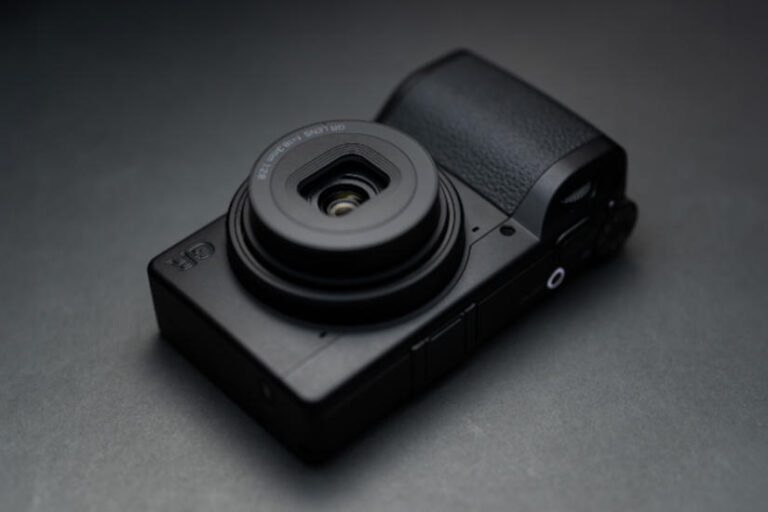
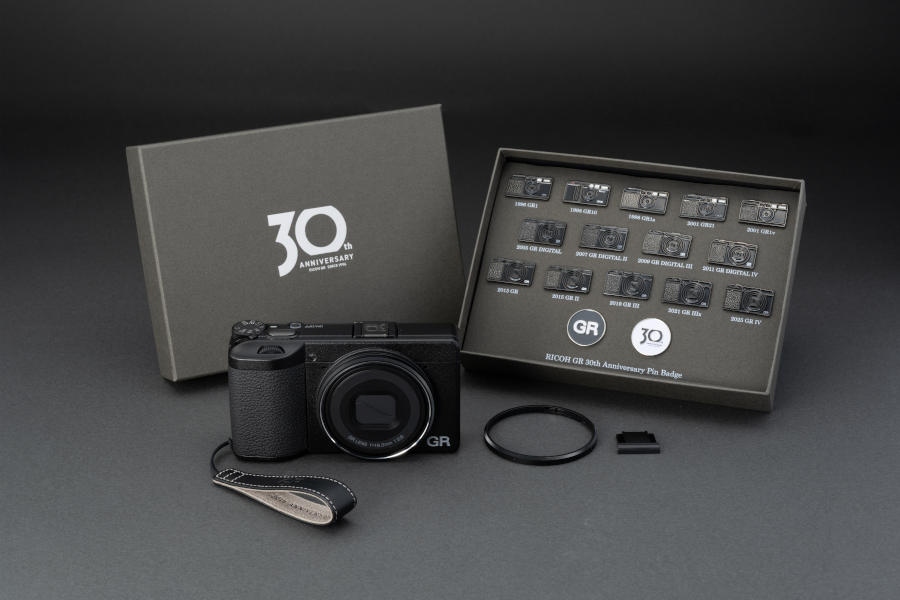
The anniversary edition uses the GR IV as its technical foundation but changes several external elements to reference the first-generation GR1. The shutter-release button and rear controls receive a special finish inspired by the plated appearance of the original film camera. The result is a visual connection between the 1996 GR1 and the current digital model without changing the fundamental GR IV camera architecture.
Ricoh also equips the camera with an exclusive GN-3 (30th) ring cap. Its diamond-cut surface takes its visual inspiration from the lens area of the original GR1. The design has a functional consideration as well: according to Ricoh, the cut surfaces are visible when the lens is retracted but are designed not to introduce unwanted reflections into the subject during shooting.
The camera also displays a dedicated 30th Anniversary graphic when it is switched off. This is a small software-level change, but it forms part of the broader anniversary treatment and distinguishes the limited model from the standard GR IV.
The GR IV imaging platform remains unchanged
The anniversary model retains the GR IV’s newly developed back-illuminated APS-C-size CMOS sensor, with approximately 25.74 effective megapixels. Ricoh designed the sensor to provide high sensitivity and reduced noise while taking advantage of the light transmitted by the camera’s newly developed lens.
The GR IV uses an 18.3mm F2.8 GR lens, corresponding to approximately 28mm in 35mm-equivalent terms. The optical construction consists of seven elements in five groups and includes three aspherical elements. Ricoh uses high-refractive-index and low-dispersion glass together with precision-molded aspherical elements to maintain image quality within the camera’s compact lens unit.
The 28mm-equivalent field of view places the GR IV within a traditional focal-length range for documentary, street and everyday photography. It provides enough surrounding context for environmental images while remaining suitable for relatively close shooting. The camera also offers crop modes corresponding to 35mm and 50mm-equivalent angles of view, although these modes reduce the recorded image dimensions compared with the full sensor output.
GR ENGINE 7 and faster camera response
The GR IV introduces Ricoh’s GR ENGINE 7 image-processing engine. The processor works with the new sensor and lens to improve image processing, detail reproduction and camera responsiveness. Ricoh also links the engine to faster autofocus operation and the overall response expected from a snapshot-oriented camera.
One of the most notable specifications is the approximately 0.6-second startup time, which Ricoh describes as the shortest startup time in the history of the GR series. The redesigned lens barrel and optimized startup sequence contribute to this result. For a camera designed around spontaneous photography, the ability to move quickly from carrying the camera to taking a photograph forms an important part of the operating concept.
The GR IV also incorporates five-axis sensor-shift image stabilization. Ricoh specifies performance of up to six stops at the center of the frame and up to four stops at the periphery under the applicable CIPA measurement conditions. The stabilization system addresses angular and rotational movement as well as shift-type camera shake.
Controls designed around snapshot photography
The GR IV’s body is slimmer than previous generations while incorporating a redesigned grip, thumb rest and control layout. Ricoh has adjusted the position and operation of the buttons and dials to support quick changes while shooting. The camera also allows extensive customization of the ADJ mode, Fn button, electronic dials and exposure controls.
The camera includes several features specifically intended to shorten the distance between recognizing a photographic opportunity and capturing it. Full Press Snap, for example, allows the photographer to assign a predetermined focus distance and immediately capture an image by fully pressing the shutter button. The GR IV also includes a Snap Distance Priority mode and a focus limiter for situations where controlling the focusing range is useful.
The autofocus system has also received technical updates. The GR IV uses faster sensor readout and lens drive, while image-plane phase-difference technology contributes to focusing performance. Face and eye detection are available in several autofocus modes, and the touchscreen can be used to move the focus area directly.
Image control and the 28mm shooting perspective
Beyond its hardware, the GR IV provides a range of in-camera image processing options. Ricoh lists 14 Image Control finishes, including established GR looks such as Positive Film, Negative Film and various monochrome modes, alongside newer Cinema options. Grain effects can also be adjusted in several of these modes.
The camera’s 28mm-equivalent focal length remains central to its photographic approach. It allows photographers to work close to a subject while retaining information about the surrounding environment. The built-in macro mode extends the camera’s capabilities for close-up work, with autofocus available at distances of approximately 6 to 15 centimetres from the front of the lens.
Anniversary accessories turn the camera into a collector’s edition
The GR IV 30th Anniversary Edition Kit includes several accessories that are not part of the standard camera package. One is a genuine leather finger strap carrying a “30th ANNIVERSARY” engraving on its reverse side. Ricoh describes the strap as compact and designed to take up little space during storage or transport.
Another distinctive item is the GK-2 (30th) metal hot shoe cover, finished in steel gray. The anniversary logo appears on its front while “RICOH GR” is engraved on the reverse. The accessory does not alter the camera’s imaging capabilities, but forms part of the physical design language of the limited edition.
The kit also contains a collection of 16 commemorative pin badges. Fourteen badges represent historic GR models, while the remaining two carry the 30th Anniversary logo and the GR logo. Ricoh has also announced that the 14 legacy-model badges will be offered separately, individually and as a set, while supplies last. The anniversary and GR logo badges are not scheduled for separate sale.
6,000 cameras for the worldwide market
The limited production run is one of the defining characteristics of the anniversary model. Ricoh Imaging has confirmed that only 6,000 units will be produced worldwide. The company has scheduled availability from October 21, 2026.
Ricoh’s US product page currently lists a price of US$1,799.95 for the RICOH GR IV 30th Anniversary Edition Kit. Availability and pricing can differ between markets, however, so the US price should not automatically be treated as the final European or Hungarian retail price.
The limited quantity also places the model in a different category from a conventional GR IV product update. Its photographic capabilities remain those of the GR IV, while the anniversary-specific elements address the history and collecting aspect of the GR brand. The manufacturer has therefore combined a current digital camera platform with physical references to the first GR generation and a set of historical memorabilia.
Three decades of a compact-camera concept
Ricoh’s 30th anniversary announcement describes the GR series as a line that has retained its emphasis on high image quality, quick response and portability despite major changes in imaging technology. The company has also used the anniversary message “Forever a Snapshooter” to describe its continuing focus on spontaneous photography.
The GR IV 30th Anniversary Edition therefore represents a continuation of an established product strategy rather than a new generation of imaging technology. The sensor, lens, processor, stabilization system and core operation remain those of the GR IV. The anniversary-specific elements instead connect the current camera with the GR1 introduced three decades earlier.
For photographers already familiar with the GR system, the anniversary edition provides a current GR IV in a historically referenced configuration. For collectors, the limited production quantity and the dedicated accessories distinguish it from the regular production model. The camera consequently occupies both a photographic and commemorative role within the GR product line.
The RICOH GR IV 30th Anniversary Edition Kit will become available on October 21, 2026, exactly around the period in which Ricoh marks three decades since the introduction of the original GR1 in October 1996. With 6,000 units allocated worldwide, the anniversary model will remain a limited part of the GR IV generation while preserving the compact-camera concept that has defined the series since its film origins.