

A lighter and faster professional telephoto zoom for Nikon Z mirrorless cameras
Nikon has announced the new NIKKOR Z 70–200mm f/2.8 VR S II, the second-generation version of its professional fast telephoto zoom lens designed for full-frame FX-format mirrorless cameras. The new model refines the concept of the widely used 70–200mm f/2.8 lens, introducing improvements in autofocus performance, optical design, and weight reduction. According to the manufacturer, the lens is now the lightest in its class, targeting professional photographers and videographers who require high reliability and consistent performance.
The 70–200mm focal range has long been considered one of the most versatile zoom ranges in professional photography. It is commonly used in fields such as sports photography, portrait photography, wedding photography, and event coverage. Combined with a constant f/2.8 aperture, lenses in this category provide strong low-light capability and allow photographers to produce images with shallow depth of field and pronounced background separation.
With the NIKKOR Z 70–200mm f/2.8 VR S II, Nikon introduces a redesigned optical and mechanical structure intended to improve usability and image quality while reducing the overall weight of the lens.
Weight reduction and improved portability
One of the key design goals of the new lens was to reduce weight without compromising durability or optical performance. The NIKKOR Z 70–200mm f/2.8 VR S II weighs 998 grams, making it the lightest lens in its class. Compared with the first-generation version, the new model is approximately 26 percent lighter and 12 millimeters shorter.
Revised lens group configuration
Engineers achieved this reduction by modifying the configuration of the front lens groups and eliminating several mechanical components within the moving optical assemblies. These changes allowed Nikon to simplify the structure of the lens while maintaining its optical precision.
For photographers working long hours in the field—such as sports photographers or wedding photographers—weight reduction can directly influence handling and fatigue levels. A lighter telephoto zoom lens is also easier to balance when mounted on stabilizing systems such as gimbals or monopods.
Silky Swift VCM autofocus system
Faster autofocus for moving subjects
The lens introduces Nikon’s Silky Swift VCM (SSVCM) autofocus drive system. This technology provides faster and more precise autofocus operation for both still photography and video recording.
According to Nikon’s internal measurements, autofocus speed is approximately 3.5 times faster than that of the previous generation. This improvement is particularly relevant in situations where subjects move quickly or unpredictably.
Improved autofocus tracking during zooming
Another enhancement involves autofocus tracking performance while zooming. Nikon states that AF tracking during zoom operation has improved by approximately 40 percent, allowing the camera and lens to maintain focus more accurately when photographers adjust focal length during continuous shooting.
This capability can be beneficial when photographing sports, wildlife, or motorsports, where subjects frequently change distance relative to the camera.
Optical design and image rendering performance
The optical construction of the NIKKOR Z 70–200mm f/2.8 VR S II has been completely revised. Nikon reduced the number of lens elements and optimized their placement to maintain high optical performance while contributing to the lighter overall structure.
Advanced optical elements
The lens uses six different types of optical elements designed to control aberrations and maintain clarity across the zoom range:
- Super Extra-low Dispersion (Super ED) elements
- Aspherical ED elements
- ED elements
- Aspherical elements
- Fluorite elements
- Short-wavelength Refractive (SR) elements
These specialized components address optical issues such as chromatic aberration, distortion, and color fringing. Correcting these aberrations is particularly important in telephoto lenses, where optical errors tend to become more visible toward the edges of the frame.
Eleven-blade diaphragm for bokeh rendering
The lens includes an 11-blade rounded diaphragm, which contributes to the shape and quality of out-of-focus highlights. When used at wider apertures, the circular diaphragm design helps produce smooth and consistent bokeh, a characteristic frequently sought in portrait and wedding photography.
Advanced anti-reflection coatings
To improve contrast and suppress unwanted reflections, Nikon applied two specialized coatings to the lens elements.
Meso Amorphous Coat
The Meso Amorphous Coat represents Nikon’s most advanced anti-reflection coating technology to date. It is designed to reduce internal reflections that can lead to flare or ghosting, especially when shooting against strong light sources.
ARNEO Coat
In addition to the Meso Amorphous layer, the lens uses ARNEO Coat, another Nikon-developed coating that helps suppress ghosting caused by light entering the lens from vertical angles. The combination of these coatings aims to maintain contrast and color accuracy even in challenging lighting conditions.
Close focusing capabilities
The NIKKOR Z 70–200mm f/2.8 VR S II allows photographers to focus relatively close to their subjects compared with many telephoto zoom lenses.
Minimum focusing distance
- 0.38 meters at the wide end (70mm)
- 0.8 meters at the telephoto end (200mm)
These distances enable photographers to capture tight compositions without switching to a macro lens.
Maximum reproduction ratio
The lens offers a maximum reproduction ratio of 0.3× at 70mm and 0.25× at 200mm, allowing relatively detailed close-up images. This capability can be useful for photographing small objects, details in event photography, or environmental portrait elements.
Tripod compatibility and professional workflow
Arca-Swiss tripod head compatibility
The NIKKOR Z 70–200mm f/2.8 VR S II is the first NIKKOR lens designed to support Arca-Swiss tripod heads directly. The Arca-Swiss system is widely used in professional photography due to its quick-release design and stability.
Direct compatibility allows photographers to mount the lens on a tripod without requiring additional adapter plates, simplifying setup and reducing overall equipment complexity.
Removable tripod collar
The lens includes a removable tripod collar ring, which facilitates switching between portrait and landscape orientation. A protective cover is also provided so that the lens can be used comfortably in handheld configurations when the collar is removed.
Internal zoom design and durability
Stable handling with internal zoom
The lens uses an internal zoom mechanism, meaning the external length of the lens remains constant while zooming. This design maintains the center of gravity, which improves balance when shooting handheld or when using stabilizing rigs.
Internal zoom systems are often preferred in professional lenses because they also reduce the movement of external components that could potentially introduce dust or moisture into the lens.
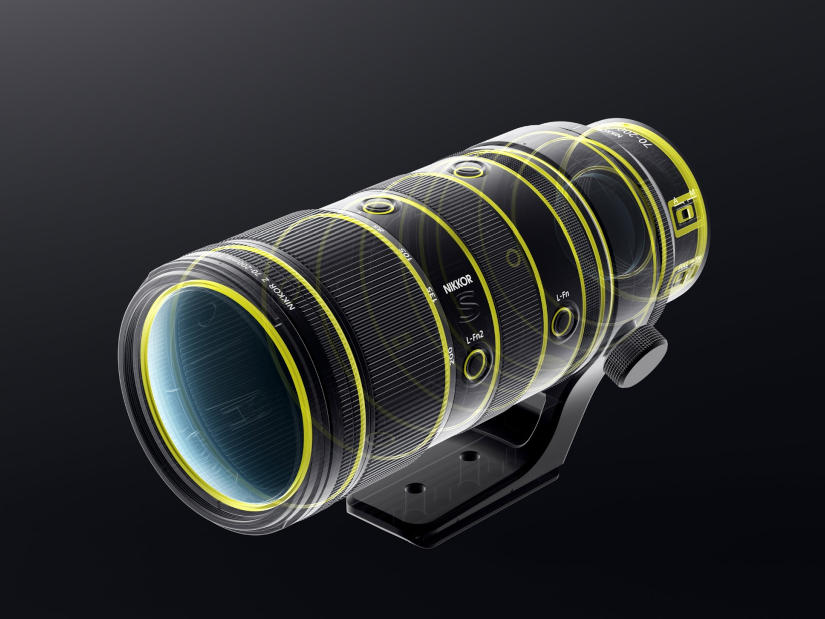
Dust and drip resistance
Nikon states that the lens is designed with dust- and drip-resistant construction, allowing photographers to operate in a range of environmental conditions. The front lens element also features a fluorine coating, which helps repel water, oil, and dirt, making cleaning easier during field use.
Vibration reduction and video usability
The NIKKOR Z 70–200mm f/2.8 VR S II provides up to 6.0 stops of vibration reduction (VR) when paired with compatible cameras that support Nikon’s Synchro VR system. This stabilization performance applies across both the center and edges of the image frame.
Such stabilization can help photographers maintain sharp images when shooting handheld at slower shutter speeds. It also supports smoother footage when recording video without external stabilization equipment.
Control ring click switch
The lens also introduces a control ring clicking switch, allowing users to enable or disable tactile clicks on the control ring. This feature can be useful for video shooters who prefer silent aperture adjustments during recording.
Teleconverter compatibility
For photographers who require additional reach, the lens is compatible with Nikon’s Z TELECONVERTER TC-1.4× and Z TELECONVERTER TC-2.0× accessories.
Using these teleconverters effectively extends the maximum focal length:
- With TC-1.4×, the lens becomes approximately 98–280mm
- With TC-2.0×, the lens reaches 140–400mm
This flexibility allows photographers to adapt the lens to different shooting scenarios, particularly when capturing distant subjects.
Price and availability
Nikon plans to release the NIKKOR Z 70–200mm f/2.8 VR S II in late March 2026. The manufacturer lists a suggested retail price of $3,199.95 in the United States.
With its revised optical design, lighter construction, and updated autofocus system, the lens represents the latest iteration of one of the most widely used focal ranges in professional photography. For users of the Nikon Z mirrorless system, the NIKKOR Z 70–200mm f/2.8 VR S II expands the company’s lineup of S-Line professional lenses, designed to meet the technical requirements of demanding photographic workflows.