
Traces: Kovácsné Doroghy Dóra Turns Invisible Wounds into Conceptual Portraits
Hungarian photographer Kovácsné Doroghy Dóra explores identity, memory and invisible emotional traces in Traces, a twelve-image conceptual portrait series.

What does a photograph reveal when the subject itself cannot be seen? In her conceptual portrait series Traces, Hungarian photographer Kovácsné Doroghy Dóra explores the invisible marks left by experience, memory and emotional change.
When Portrait Photography Looks Beyond the Face
Portrait photography is often associated with recording a person’s appearance, expression or presence at a particular moment. Conceptual portraiture approaches the subject differently. Rather than simply describing who someone is, it can use the human figure as a starting point for exploring ideas that cannot be photographed directly.
Hungarian photographer Kovácsné Doroghy Dóra takes this approach in Traces, a twelve-image conceptual portrait series examining the invisible marks that significant experiences can leave behind. The project addresses identity, loss, anxiety, inner conflict, transformation and the process of confronting experiences that may remain hidden from others.
The series will be presented in the photographer’s first solo exhibition, opening on 12 October 2026 at 6:00 p.m. at the Móra Ferenc Cultural Centre in Kiskunfélegyháza, Hungary. While the exhibition provides the immediate context for the project, Traces can also be viewed independently as an example of how contemporary portrait photography can translate psychological and emotional ideas into visual form.
From Personal Experience to Visual Language
Dóra describes her photographic interest as being rooted in stories that people do not necessarily express openly. Instead of treating photography as a straightforward record of reality, she uses portraiture, symbolic elements and atmosphere to construct images around internal states.
This distinction is central to Traces. The photographs do not attempt to document psychological conditions in a clinical or scientific sense. They represent the photographer’s artistic interpretation of experiences such as fear, loss, uncertainty, letting go and the search for identity.
The project therefore belongs to a broader tradition of conceptual photography in which the photograph does not simply answer the question of what happened? Instead, it can ask what does this experience feel like? or what remains after the experience has passed?
The human figure remains essential, but it is no longer the entire subject. Body language, facial expression, surroundings and symbolic visual elements become parts of a larger composition. Together, they suggest an internal narrative without necessarily explaining it.
The Meaning of an Invisible Trace
The title Traces refers to something that remains after an event has occurred. In everyday language, a trace can be physical evidence, a memory or an effect that continues to influence the present. In the context of photography, the word carries another layer of meaning: every photograph is itself a trace of a particular moment.
Dóra’s project brings these two meanings together.
A photograph preserves something that existed in front of the camera, while the subject of Traces concerns experiences whose consequences may not be visible at all. The camera can record a face or body, but it cannot directly photograph memory, fear, grief or the gradual reconstruction of identity.
Conceptual photography provides a way around this limitation. Instead of attempting to photograph an invisible emotion literally, the photographer can construct a visual metaphor for it.
This approach allows the image to operate on several levels simultaneously. It can remain a portrait of a person while also functioning as an image about an idea. The resulting photograph does not need to provide a single, definitive interpretation.



Twelve Images, Twelve States of Mind
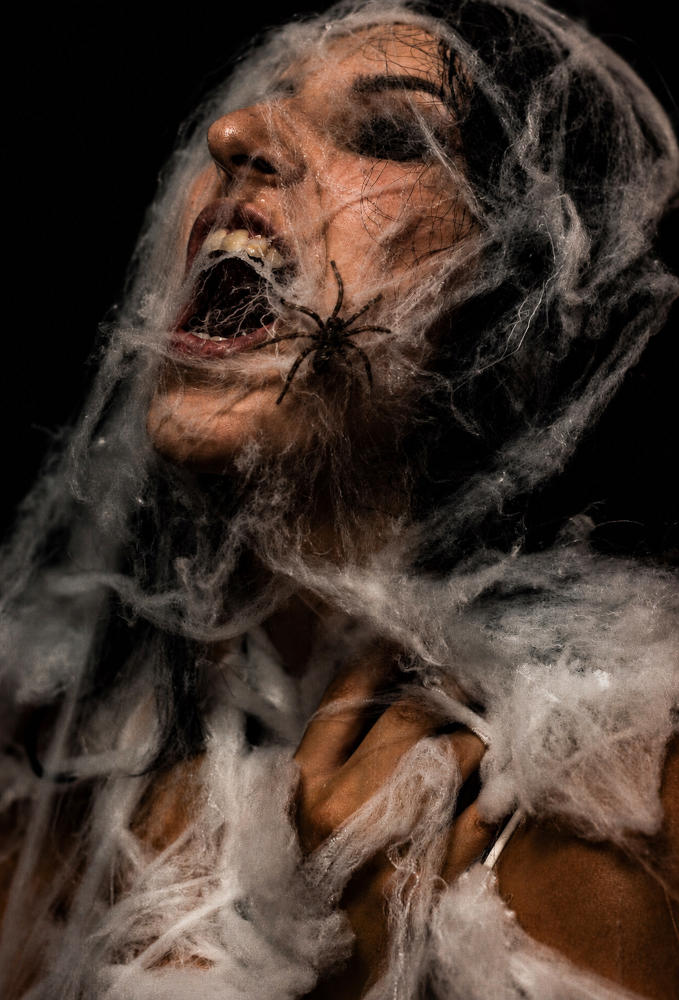
Traces consists of twelve photographs conceived as individual stations within a larger visual journey. The works do not form a conventional documentary sequence and are not intended to illustrate a single linear biography.
Each image approaches a particular feeling, psychological state or internal conflict. The relationship between the portraits creates the broader structure of the project.
This method is particularly relevant to conceptual portrait photography because the meaning of an individual image can change when it is viewed alongside other photographs. A symbol introduced in one work may acquire another association later in the sequence. A visual motif may become part of a larger narrative without the photographer having to explain it explicitly.
The twelve images can therefore be approached both individually and as a collective body of work.
For international audiences encountering the project without knowing the photographer’s personal background, this openness becomes an important part of the viewing experience. The photographs are rooted in Dóra’s own artistic perspective, but their themes do not depend exclusively on knowledge of her biography.
Photography as Metaphor
One of the defining characteristics of Traces is its use of visual symbolism. The photographs are constructed rather than purely observed. Their elements are selected because they contribute to the conceptual framework of the project.
This places the work closer to staged and conceptual portrait photography than to traditional documentary portraiture.
In documentary photography, the photographer often responds to an existing situation. In a conceptual project, the process can begin in the opposite direction: an idea or question comes first, followed by the construction of an appropriate visual situation.
The distinction does not mean that one approach is more authentic than the other. They simply use photography for different purposes. In Traces, the camera becomes a tool for translating an internal concept into an external image.
The resulting visual language occupies the space between reality and imagination. Familiar elements can acquire unfamiliar meanings when they are removed from their ordinary context and incorporated into a carefully constructed portrait.
The Role of Darkness in the Series
The visual atmosphere described by the photographer is predominantly dark and unsettling. However, darkness in this context is not presented as an end in itself.
Dóra connects the darker visual language with the process of confronting difficult experiences. The photographs are intended to address subjects that can be uncomfortable to acknowledge, while the overall project also leaves room for transformation and hope.
This creates an important distinction between a photographic series about suffering and a series that uses difficult subjects as part of a broader exploration of change.
The images do not provide a psychological diagnosis or prescribe a particular interpretation. Instead, they create visual situations in which viewers can consider their own associations with the themes presented.
That open structure is consistent with conceptual photography, where ambiguity can be an intentional part of the work rather than a problem that needs to be resolved.
The Viewer Becomes Part of the Interpretation
A conceptual photograph does not necessarily have one fixed meaning. The photographer may establish the conceptual framework, but the viewer completes the process through observation and association.
This is particularly relevant to Traces. The project begins with personal experience, yet its central themes are not limited to one individual biography. Questions of identity, loss, fear, transformation and memory can be approached from many different perspectives.
A viewer may therefore read the same image differently from the photographer who created it. A particular object may suggest loss to one person and protection to another. A gesture may evoke vulnerability for one viewer and resilience for someone else.
Rather than eliminating these differences, conceptual photography can use them as part of the work.
In this sense, Traces does not ask viewers simply to discover what the photographer intended. It also invites them to consider what their own response to the images reveals.
Between Portraiture and Conceptual Photography
The project occupies an interesting position between two established photographic approaches.
Portraiture traditionally places the individual at the centre of the image. Conceptual photography often places an idea at the centre. Traces combines the two by using the portrait as the visual vehicle for an abstract subject.
The face and body provide a human point of reference, while the surrounding visual language introduces meanings that cannot be reduced to physical appearance.
This approach demonstrates why conceptual portrait photography has become an increasingly useful form for photographers interested in identity and subjective experience. The portrait does not have to explain the individual completely. It can instead reveal a fragment, construct a metaphor or deliberately leave something unresolved.
For the photographer, this also changes the creative process. The question is no longer simply how to photograph a person, but how to build an image capable of communicating an idea through that person.
A Personal Project with a Broader Subject
Dóra describes Traces as her first body of work in which she allowed herself considerable freedom to translate her own inner world into photographs. The series consequently has a strongly personal starting point.
Personal projects can occupy a particular position within contemporary photography. They allow photographers to investigate subjects that may not fit the requirements of commissioned or documentary assignments. At the same time, the strongest personal projects often become accessible to wider audiences because they address experiences beyond the individual creator.
Traces follows this direction. Its starting point is personal, but its conceptual vocabulary is broader: the marks left by experience, the construction of identity and the process of change are not confined to one person’s story.
This balance between personal authorship and wider interpretation is one of the central characteristics of the project.
From the Visible to the Invisible
Photography has an obvious relationship with visibility. The medium records light reflected from the physical world and turns it into an image. Yet photographers have repeatedly used photography to address subjects that cannot be seen directly.
Memory, absence, identity, time and emotion are common examples. They can be suggested through objects, spaces, gestures, lighting, composition and the human body.
Traces works within this broader photographic tradition. Its subject is not the invisible itself as an abstract concept, but the way invisible experiences can leave visible consequences.
A face can change. A posture can suggest tension. A physical environment can become a metaphor. A carefully constructed composition can create a sense of isolation or transition.
None of these elements objectively proves an internal emotional state. Instead, they establish a visual language through which such a state can be imagined.
The Exhibition in Kiskunfélegyháza
The first solo presentation of Traces will take place at the Móra Ferenc Cultural Centre in Kiskunfélegyháza, Hungary, on 12 October 2026.
The venue is part of the cultural infrastructure of Kiskunfélegyháza and has hosted exhibitions, cultural programmes and community events. The building itself has a long local history. According to the city of Kiskunfélegyháza, the building originally operated as the Korona Hotel before becoming the home of the cultural centre in 1957. It was renovated in 1996 and expanded in 2010.
For Dóra, the exhibition represents more than the presentation of twelve finished photographs. She describes the series as the beginning of a new artistic direction rather than a closed chapter.
The opening event is also planned to extend beyond a conventional gallery presentation. According to the exhibition press material, the photographs will be incorporated into a special visual experience during the opening evening, allowing the works to appear in a different context from the standard exhibition environment.
An Ongoing Photographic Practice
The presentation of Traces marks an important point in Dóra’s development as a photographer, but the project itself suggests an ongoing process rather than a definitive statement.
The photographer describes the series as the first step of a new creative path. Its conceptual framework could therefore be understood not simply as the subject of one exhibition, but as an indication of the questions that may continue to inform her photographic practice.
Those questions concern the relationship between external appearance and internal experience, the role of memory in identity, and the possibility of using photography to represent experiences that have no direct visual form.
These questions have no single photographic solution. Different photographers approach them through documentary work, staged photography, self-portraiture, abstraction or mixed visual practices. Traces chooses conceptual portraiture as its principal language.
Why Conceptual Portraiture Matters
The value of conceptual portraiture lies partly in its ability to expand what a portrait can represent. A portrait does not necessarily have to tell viewers everything about a person. It can instead create a space in which questions about identity and experience become visible.
In Traces, the individual photograph functions both as portrait and metaphor. The person remains physically present, while the conceptual framework encourages the viewer to look beyond the literal appearance of the subject.
This makes the project relevant not only as a personal exhibition but also within the wider discussion of contemporary portrait photography.
The series demonstrates one of the fundamental possibilities of the photographic medium: the ability to transform an intangible idea into a concrete visual experience without claiming that the photograph can literally reproduce the invisible.
Traces as an Invitation to Look Again
Kovácsné Doroghy Dóra’s Traces begins with a simple distinction: some marks can be seen, while others remain hidden.
The twelve-image series explores what happens when photography attempts to give visual form to the latter. Rather than documenting invisible wounds directly, Dóra constructs symbolic portraits around the experiences associated with them.
The result is a conceptual photographic project positioned between portraiture, staged photography and visual metaphor. Its subject is personal, but its questions are deliberately broader.
The first solo exhibition in Kiskunfélegyháza will provide the opportunity to encounter the twelve photographs as a complete body of work. Beyond the exhibition itself, Traces offers a useful example of how contemporary photographers can use the portrait not simply to record a person, but to investigate what remains hidden behind the visible image.
Traces – Kovácsné Doroghy Dóra
Móra Ferenc Cultural Centre, Kiskunfélegyháza, Hungary
Opening: 12 October 2026, 6:00 p.m.
Series: 12 conceptual portraits
Artist: Kovácsné Doroghy Dóra / PhoDora