The Art of Still Life Photography

Mastering Composition, Lighting, and Storytelling
Still life photography is one of the most foundational and enduring genres in the visual arts. Dating back to classical oil paintings of the Dutch Masters, the practice of arranging inert objects to convey meaning, texture, and mood has evolved into a powerhouse of artistic expression and commercial branding.
Unlike photojournalism or wildlife photography, where the artist must react instantly to fleeting moments, still life photography offers complete creative control. You decide what enters the frame, how light interacts with every surface, and where the viewer’s eye travels. Whether working with everyday household items, organic botanicals, or fine art collectibles, mastering this discipline sharpens your technical skill across all photography fields.
1. Finding Inspiration and Arranging the Scene
The secret to compelling still life imagery lies in intentional curation. A common mistake is crowding the frame with unrelated objects. Instead, aim for a cohesive narrative or visual theme:
- Color Harmony: Choose objects that complement each other. Analogous color palettes (e.g., warm earthy tones of brown, orange, and deep red) evoke nostalgia, while high-contrast complementary colors (e.g., blue and yellow) create energetic visual tension.
- Texture and Layers: Pair rough textures like weathered wood, aged paper, or linen with smooth surfaces like polished glass, ceramics, or fresh fruit to create tactile contrast.
- The Rule of Odds: Arranging elements in odd numbers (groups of three or five) creates a more balanced and visually pleasing composition than even-numbered groupings.
2. Compositional Frameworks for Still Life
Structure transforms a simple snapshot of objects into a captivating visual story. When composing your shot, consider these time-tested techniques:
- The Golden Ratio and Rule of Thirds: Position your hero object along grid intersections or organic logarithmic spirals to guide the viewer naturally through the scene.
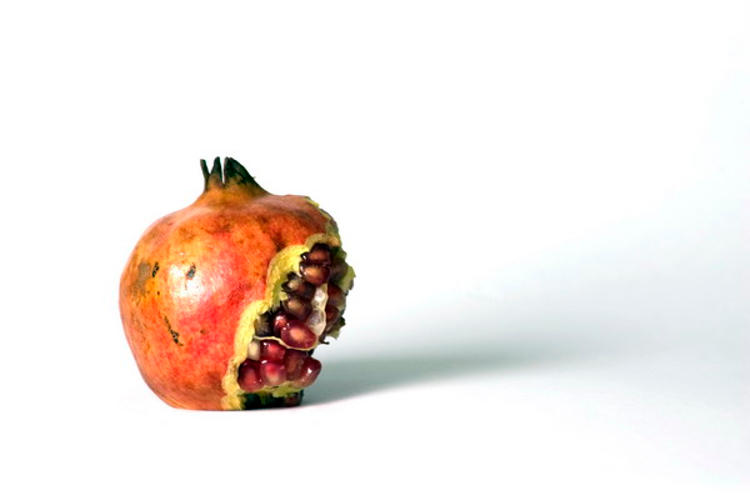
- Negative Space: Leave ample breathing room around your subject. Negative space reinforces a sense of minimalism, elegance, and calm.
- Leading Lines and Diagonals: Use table edges, fabric folds, or stems to create subtle directional paths that point toward the focal point.
3. Lighting Strategies: From Natural Window Light to Studio Precision
Lighting dictates the emotional weight of a still life photograph. You do not need expensive studio strobe arrays to capture stunning images; controlling light direction and quality is far more important than raw power.
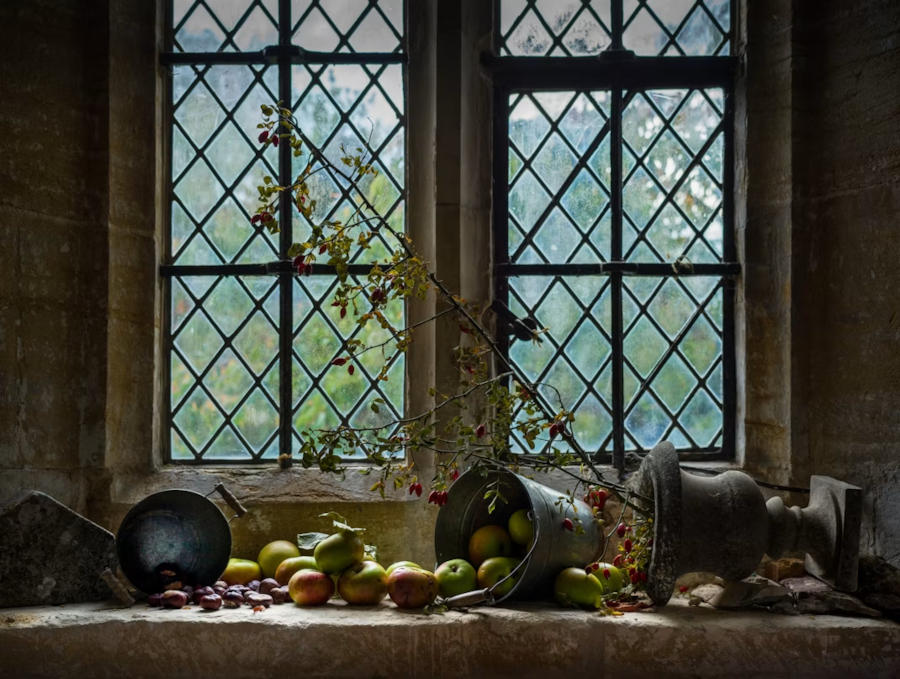
- Soft Window Light (The Classic Setup): Placing your arrangement perpendicular to a large north-facing window produces soft, directional light with gradual shadow transitions. Use a white foam board opposite the window as a fill reflector to lift harsh shadows, or a black card (negative fill) to deepen contrast.
- Moody Chiaroscuro (Dark and Dramatic): Inspired by Renaissance painters like Caravaggio, this style utilizes a single directional light source with heavy flags or grids to keep light spill contained. The background falls into deep shadows while key highlights reveal the forms of your subjects.
- Flat-Lay / High-Key Illumination: Popular in modern editorial spreads, overhead flat-lay shots require broad, shadowless, diffused lighting from overhead softboxes or bounced ambient light.
4. Lens Selection and Camera Settings
Precision is paramount in still life photography, as minor focus drift or lens distortion can diminish the quality of the image.
- Focal Length: Medium telephoto prime lenses—such as 85mm, 90mm Macro, or 105mm—are ideal. They prevent wide-angle barrel distortion and compress the perspective naturally.
- Aperture & Depth of Field: To keep all elements sharp from front to back, shoot between f/8 and f/11. If you aim for a painterly, dreamy feel with smooth background bokeh, open up to f/2.8 or f/4, focusing precisely on the most critical texture.
- Tripod and Remote Trigger: Because still life subjects are stationary, always use a sturdy tripod. This allows you to shoot at lower ISO values (ISO 100) for maximum image clarity and dynamic range, using longer shutter speeds without camera shake.
Still Life Photography
Still life photography is a meditative, deliberate craft that teaches you how to truly see light, texture, and form. By slowing down, experimenting with single light sources, and carefully controlling every element within your frame, you can transform ordinary, everyday objects into timeless visual art.
Photo: John H Rhodes